Summary
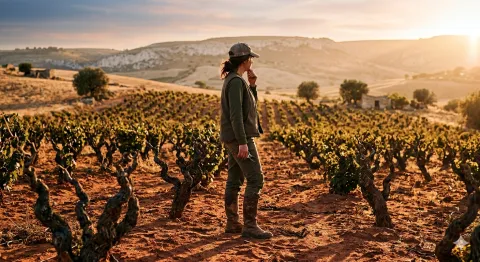
Arianna Occhipinti turned up to this interview in muddy boots. I keep coming back to that detail because it is doing a lot of work. She is not styled, not positioned, not performing the founder of a successful winery. She is someone who was out in the vineyard before the journalist arrived and will probably go back out after. That is either very real or a very well-maintained image, and after twenty-odd years of watching her operate I am inclined to believe it is the former.
She started in her early twenties with one hectare and a lot of nerve. Spent years being assessed, questioned, half-believed. She says it took ten harvests before people stopped treating every vintage as an audition and started just drinking the wine. What she does not say, but what you can read between the lines, is that being a woman in Sicilian wine added its own particular friction to all of that – she addresses it directly later in the interview, with the specific weariness of someone who is long past surprised by it but has not quite made peace with it either.
The interview covers a lot of ground and she is good value throughout. On the Etna boom she says the thing that producers in smaller territories have been thinking for years – that some of the land rush was really about needing the volcano's name to feel less provincial, less like a minor god in your own patch. She is not cruel about it. But she is clear. On the natural wine movement, which she helped build through her early involvement with Vini Veri and two decades of being its most convincing Sicilian argument, she says it lost the plot when it stopped talking about vineyards and started treating maceration and whole-bunch as ends rather than means. She compares it to oak in the nineties, which is the right comparison, and she does not exclude herself from the reckoning. On Marsala she is optimistic, conditionally – the appellation has a future if it goes back to the serious oxidative style that built its reputation, the pre-British fortified wines that aged in barrel and meant something, rather than competing with fresher lighter expressions that leave it fighting on the wrong terrain. She mentions Florio moving back towards tradition as evidence that something is shifting, and if a company that size is reading it that way, the signal is probably real.
Angiolino Maule – founder of VinNatur, a patriarch of Italian natural wine, the man who called her a fake naturalist after she appeared at Vinitaly 2025 – gets dealt with in about three sentences. She says she does not need to prove herself to anyone anymore, invites him to come and look around if he likes, and that is that. I would have enjoyed a little more heat but I understand why she does not bother. Then the interview gets to PIWI varieties and something quietly goes wrong.
Our take
I want to be honest about something before I get into this. I have tasted PIWI wines that were genuinely dull. Some of the earlier crosses were resistant to fungal disease and also, it has to be said, resistant to being particularly interesting in the glass. So I am not defending the entire category on principle. But Occhipinti says she has tasted them, finds them lacking depth, and would rather keep working with Frappato and Nero d'Avola even if that costs her extra treatment passes through the vineyard. And nobody – not the interviewer, not an editorial note, nothing – asks her which wines she actually tasted.
That matters. Because PIWI varieties – the term comes from the German pilzwiderstandsfähige, meaning fungal-resistant, developed through conventional breeding not GMO methods – have moved a lot in the last few years. Souvignier Gris, Merlot Kanthus, Soreli are producing wines in northern Italy right now that would embarrass the category's early reputation for flatness. Not all of them are there yet, not by a long way, and I would not pretend otherwise. But a blanket verdict of "not interesting, lacks depth" applied to the whole family in 2026, without specifying a single producer or vintage or variety, is not a considered opinion. It is a preference that has not been updated recently.
Add to that the fact that in Sicily, PIWI varieties are already locked out of DOC and DOCG production by Italian wine law – so Occhipinti is not just expressing a personal view, she is one of the most listened-to people in Sicilian natural wine dismissing something that is fighting uphill legally and culturally at the same time. And Gambero Rosso, which ran a serious PIWI tasting and public debate at Vinitaly 2025, published this interview without a single follow-up question on the subject. I find that genuinely baffling. Maybe the interview ran long and something got cut. I do not know. What I know is what is on the page, and what is on the page has a hole in it.
About the author
Sonia Ricci covers natural wine for Gambero Rosso and this interview shows why she is good at it – the gender section in particular is sharp, she keeps pressing where another interviewer might have accepted the first answer and moved on, and the material on the natural wine movement's drift away from terroir gets real responses rather than rehearsed ones. She has clearly done her preparation and it shows. The PIWI exchange is two questions and two answers and that is the end of it, and I genuinely do not know if that was her call or an editor's or just the momentum of the conversation carrying them past it. But it is the one place the piece needed to hold its ground and did not, and it is also, for this particular audience, the one place it mattered most.
About the publisher
My relationship with Gambero Rosso is the same complicated thing it has been for years – genuine respect for the seriousness of what they do at their best, and a permanent background awareness that they cannot fully be what they sometimes present themselves as, which is an independent critical voice. Gambero Rosso Holding S.p.A. is a media group, a training academy, an events operation, and a ratings body for the same industry it covers, more or less simultaneously. The guides are real. The tasting infrastructure is serious. The journalism, when it works, is better than most of what the Italian food and wine world produces. But the conflicts of interest are structural and they do not get acknowledged, and every so often something falls through the gap between them.
This interview is one of those moments. They ran a PIWI debate at Vinitaly 2025. They have published thoughtful coverage of resistant varieties. And then they put out this piece in which the whole subject gets four unchallenged lines from a producer with enormous influence, and apparently no one in the building noticed the problem or decided it was worth addressing. I do not think there is anything sinister in that. I think it is what happens when you are deep enough inside something that you stop being able to see where your events calendar ends and your editorial judgment begins. It happens to everyone eventually. It is just more consequential when it happens to Gambero Rosso.