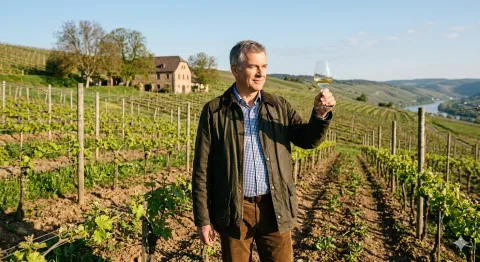
The Ice-Breaker Gets His Prize: How Ulrich Fischer Made PIWI Wines Respectable

Image
Prof. Dr. Ulrich Fischer vom DLR Rheinpfalz mit Peter-Morio-Preis 2026 geehrt
Science vindicates the resistant vine.
Article title
Prof. Dr. Ulrich Fischer vom DLR Rheinpfalz mit Peter-Morio-Preis 2026 geehrt
Link to article
Date of publication
Publisher
idw-online — Informationsdienst Wissenschaft e.V.
Author
Dipl.-Biol. Stefanie Hahn, press officer, Julius Kühn-Institut (JKI)

Summary

On 6 March 2026, at a formal colloquium held at the Julius Kühn-Institut, Prof. Dr. Ulrich Fischer of the DLR Rheinpfalz received the Peter Morio Prize 2026. The prize has been awarded since 1993 for outstanding contributions to grapevine breeding and breeding research, and it is not handed out casually. Fischer earned it the hard way—by spending years persuading an industry that trusts its gut more than its laboratory that the pilzwiderstandsfähigen Rebsorten, the fungus-resistant PIWI varieties, actually belong in a serious wine glass. Laudator Prof. Dr. Oliver Trapp, who leads the grapevine breeding institute at the JKI, put it plainly: Fischer broke the ice with skeptical producers not through authority but through communication—entertaining, technically precise, and impossible to dismiss.

The research underneath that communication is substantial. Fischer's team and the JKI spent nine years on the SelWineQ project, hunting for molecular markers in the grapevine genome that predict sensory and aroma characteristics—the kind of work that could cut years off the breeding cycle for new resistant varieties. He is currently supervising a doctoral thesis on PIWI wine styles from the Geilweilerhof collection, keeping the pipeline from vine to laboratory to glass firmly open. He also directed the dual-degree programme in viticulture and oenology at Wine Campus Neustadt—the first of its kind in Germany. Vinum Magazine listed him among Germany's 25 most important wine personalities in both 2021 and 2022. The prize is named after Peter Morio (1887–1960), the breeder behind Bacchus, Morio Muskat, Optima, and Domino—varieties that reshaped German viticulture in their own time, just as Fischer is trying to reshape it in ours.

Our take

There is something quietly telling about the way this press release is written. Fischer clearly did something real—nine years of genomic research, a doctoral pipeline still running, producers who changed their minds because of his work. That deserves acknowledgment. But the text never once steps outside the ceremony to ask why, if the science is this persuasive, PIWI adoption in Germany remains so patchy. The gap between proof and practice is the actual story here, and the JKI press office walked straight past it. You cannot blame a press release for being a press release. But you can notice what it chose not to say. Fischer broke the ice with winemakers. Nobody in this text broke the ice with the truth.

About the author

Dipl.-Biol. Stefanie Hahn is the press officer at the Julius Kühn-Institut. There is no external journalistic profile to assess. What the text itself reveals is competence and institutional loyalty in equal measure—the piece is well-constructed, warm where it should be warm, and carefully silent where honest reporting might create friction. That is what press officers are hired to do. It is not a criticism of Hahn personally; it is simply a description of the role.

About the publisher

idw-online—the Informationsdienst Wissenschaft—has been running since 1995 and has become the primary press wire for German-language science institutions, reaching over 45,000 subscribers including roughly 9,800 journalists. It is financially independent and organised as a non-profit. What it is not is an editorial operation. It distributes what its roughly 1,000 member institutions submit, with quality checks on craft but not on critical angle. For a reader wanting to know what German research institutions want the public to know, idw is indispensable. For a reader wanting independent scrutiny of those same institutions, it is the wrong address.